Training
Bigger biceps come down to three muscles working together.
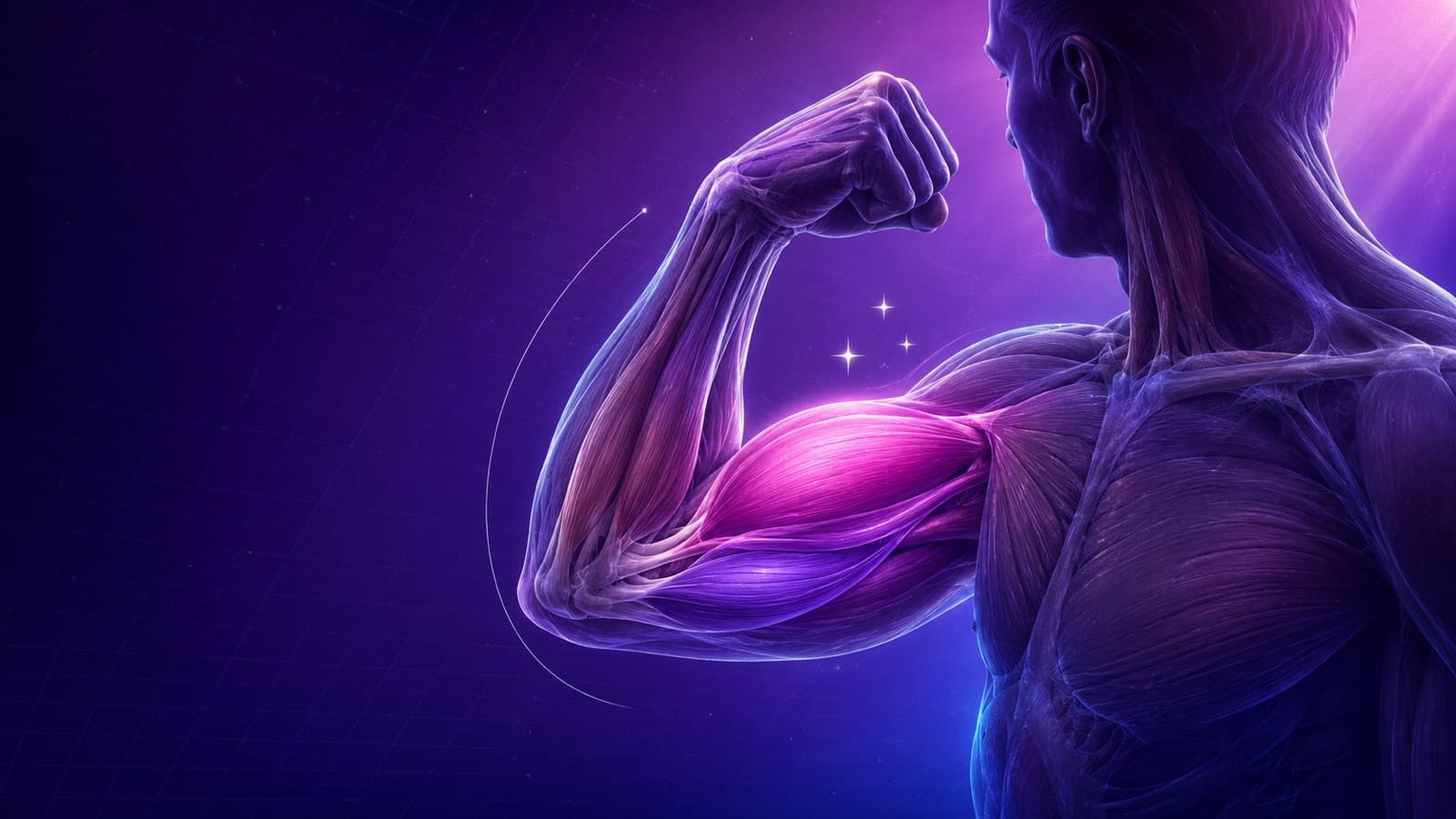
Your upper arm is really three structures: the long head of the biceps that forms the peak, the short head that adds width, and the brachialis underneath that pushes everything up. Bigger arms come from training all three, and each one responds to a different position. One good exercise for each is the whole formula.
Key takeaways
- Your upper arm is built by three structures: the two heads of the biceps (long and short) and the brachialis underneath.
- The long head is the outer part that forms the bicep peak. It works hardest with your arm behind your body, so incline curls and concentration curls target it best.
- The short head is the inner part that adds width and thickness. It works hardest with your arm in front of your body, so preacher curls and EZ bar curls target it best.
- The brachialis sits under the biceps and pushes it up, adding size without training the biceps directly. Hammer curls and reverse curls target it.
- You don't need all six exercises every session. One exercise per muscle covers every angle, and that's the formula for bigger arms.
The part that trips people up is that the biceps has two heads, not one. The long head runs down the outside of your arm and the short head down the inside, and each one gets worked differently depending on where your arm sits. The brachialis is a separate muscle underneath the biceps, and it adds size the biceps alone can't.
So the position of your arm matters as much as the number of reps. Behind your body, out in front of it, or palms-down all shift the work to a different structure. Train each one in the position it likes and the whole arm gets bigger. Here's what each does and the two moves that hit it best.
The long head: taller peaks
The long head is the outer portion of your biceps, and it's the part that creates the visible peak. It's what makes an arm look full and tall when you flex. The long head works hardest when your arm is behind your body, which is why stretch-focused curls hit it best.
Incline dumbbell curls. Set a bench to about 45 to 60 degrees, sit back, and let your arms hang behind your torso. That stretched position at the bottom is exactly where the long head does its work.
Concentration curls. Plant your elbow on your inner thigh, isolate the arm, and squeeze at the top. Keep the swing out of it. The more you cheat the weight up, the less the long head has to do.
The short head: width and thickness
The short head sits on the inner side of your arm and drives the overall thickness and width of the biceps. It's most active when your arm is out in front of your body. If your arms look flat from the front, the short head is what you're missing.
Preacher curls. The preacher bench locks your arm in front of your body and kills any chance of cheating. That position is exactly what the short head wants, especially if you control the lowering (eccentric) phase instead of dropping the weight.
EZ bar curls. The angled grip on an EZ bar takes pressure off your wrists while keeping your arms in a position that hammers the short head. Good for loading up volume without beating up your joints.
The brachialis: a bigger base
The brachialis sits underneath the long head. Training it pushes the biceps up from below, so the whole arm looks bigger even without adding size to the biceps directly. It's the most overlooked muscle in arm training and one of the easiest ways to add real thickness.
Hammer curls. Keep your palms facing each other the whole way through. That neutral grip shifts the work off the biceps and onto the brachialis and your forearms.
Reverse curls. Flip your grip so your palms face down. This takes the biceps almost fully out of the movement and forces the brachialis to carry the load.
Putting it together
You don't need to train all six of these every session. If you're building a bicep-focused workout, hit at least one exercise per muscle: one for the long head, one for the short head, one for the brachialis. That covers every angle your arm grows from, and it's the whole formula for bigger biceps and stronger arms.
Want every biceps movement in one place? The full biceps libraryhas each one with form cues and the muscles it hits. And if you'd rather have a plan built for you, our free AI workout generator puts a program together in 30 seconds, and the Kovo app works arm training into every week for you.
Frequently asked questions
How many muscles make up the biceps?
The biceps brachii has two heads: the long head on the outside of your arm and the short head on the inside. A third muscle, the brachialis, sits underneath the biceps and adds to arm size, so most bicep training targets three structures in total.
How do I get a bigger bicep peak?
The peak comes from the long head, the outer part of the biceps. It works hardest when your arm is behind your body, so stretch-focused moves like incline dumbbell curls and concentration curls target it best. Build the long head and the peak follows.
What exercises work the short head of the biceps?
The short head is most active when your arm is out in front of your body. Preacher curls and EZ bar curls both keep the arm in front and load the short head, which is what adds width and thickness to the biceps and fills the arm out from the front.
Does training the brachialis make your arms bigger?
Yes. The brachialis sits underneath the biceps, so building it pushes the biceps up and makes the whole arm look bigger, even though you're not adding size to the biceps directly. Hammer curls and reverse curls, with a neutral or palms-down grip, train it.
What is the best exercise for bigger biceps?
There isn't a single one. Bigger arms come from training all three structures: the long head with incline or concentration curls, the short head with preacher or EZ bar curls, and the brachialis with hammer or reverse curls. One exercise per muscle is enough.
We build your program. You play through it.
Streaks, quests, levels, and friends in your gym. Free on iOS and Android.