Training
A bigger chest comes down to three areas: upper, middle, and lower.
Your chest is one muscle, the pec major, but it works at three angles: the upper fibers near your collarbone, the middle, and the lower. Change the angle you press at and the work shifts to a different area. A bigger, fuller chest comes from hitting all three, and the upper and lower are the parts most people skip.
Key takeaways
- Your chest is one muscle, the pec major, worked at three angles: upper, middle, and lower.
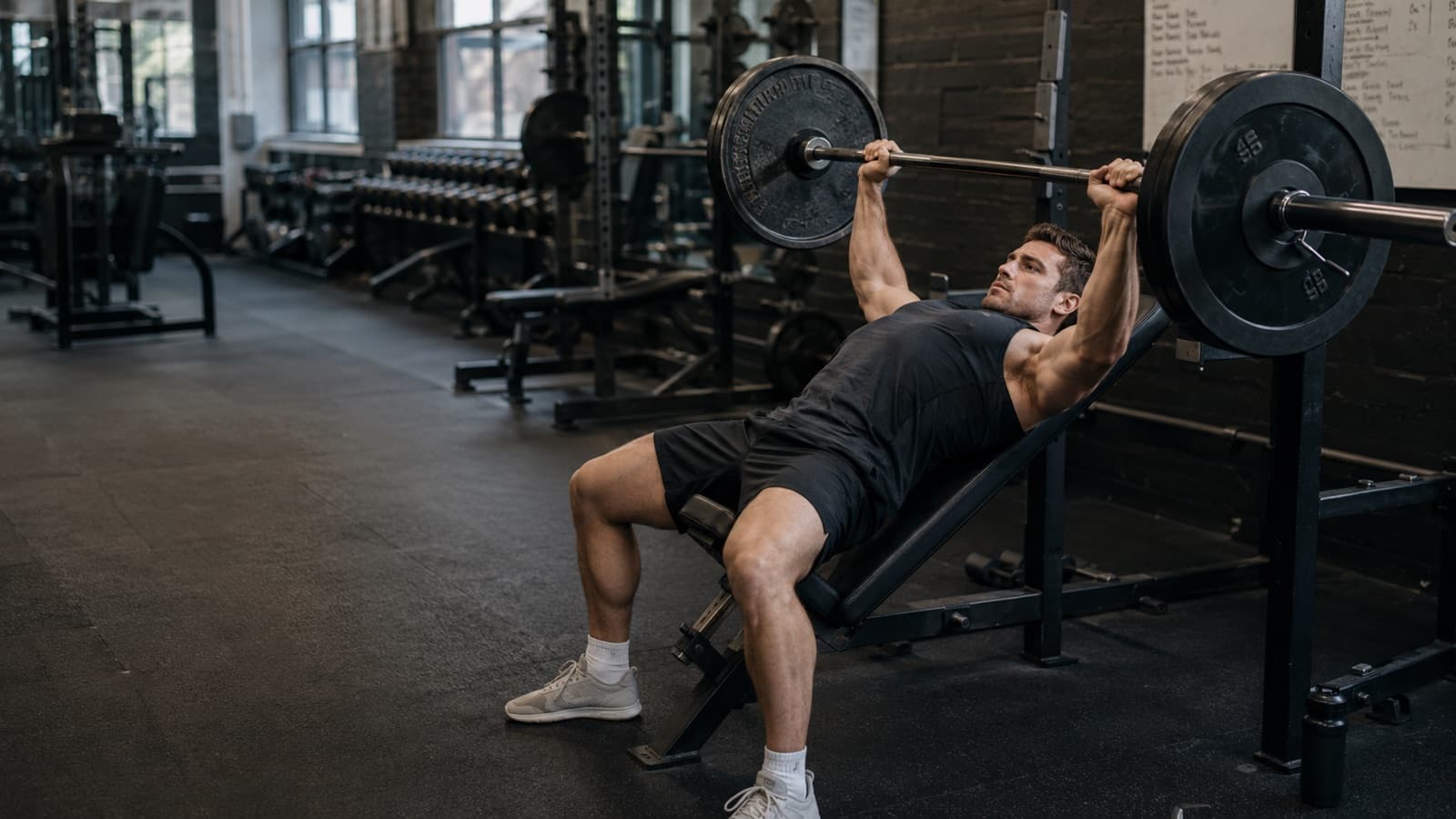
- The upper chest works hardest on an incline. Train it with incline barbell bench press and incline dumbbell flyes, bench set 30 to 45 degrees.
- The middle chest is built with flat pressing: flat barbell bench press and flat dumbbell press.
- The lower chest responds to pressing or flying on a downward angle. Weighted dips (torso leaned forward) and high-to-low cable flyes target it.
- A balanced chest day is one upper movement, one to two middle movements, and one lower movement. Train chest once or twice a week.
The pec major fans out from your collarbone down to your sternum, so the angle you press at decides which fibers do the most work. Press on an incline and the upper fibers take over. Press flat and the middle does most of it. Lean forward on a dip or fly downward and the lower fibers carry the load.
That's why a chest built on flat bench alone tends to look full through the middle and flat up top. Train all three angles and the chest fills out from the collarbone down. Here are the two moves for each area, and how to put them into one chest day.
Upper chest
The upper chest is the set of fibers running up toward your collarbone, and it's what makes a chest look full from the top instead of dropping off. It fires hardest on an incline, so this is where the bench angle earns its keep.
Incline barbell bench press. Set the bench between 30 and 45 degrees. Any steeper and you start turning this into a shoulder press. If you feel your shoulders taking over, drop the incline a notch and focus on driving your elbows up and in as you press.
Incline dumbbell fly. Lie back on that same incline and let the dumbbells travel out wide before bringing them back together over your chest. Keep a slight bend in your elbows the whole way through. Locking your arms out turns it into a shoulder exercise.
Middle chest
The middle chest is the bulk of the muscle and the part most lifters train by default. Flat pressing is where you build raw chest strength and the thickness through the middle of the pec.
Flat barbell bench press. The standard for chest strength. Keep your feet planted, your shoulder blades pinned back, and drive the bar in a straight line over your chest. Lower it to the same spot every rep, usually just below the nipple line, instead of letting it drift toward your neck or stomach.
Flat dumbbell press. Easier on the shoulders than a barbell, and it forces each side of your chest to work on its own. Let the dumbbells dip slightly below your chest at the bottom for a deeper stretch than a barbell can give you.
Lower chest
The lower chest is the bottom edge of the pec, and training it is what gives the chest a defined line underneath instead of blending into your stomach. It works best when you press or fly on a downward angle.
Weighted dips. Lean your torso forward and let your elbows flare out slightly. That forward lean is what shifts the work off your triceps and onto your lower chest. Only go as deep as your shoulders allow without pain.
Cable fly, high to low. Set both pulleys above your head and bring your hands together out in front of your hips. Squeeze your chest hard at the bottom, and resist on the way back up.
Building your chest day
You don't need to hit all six of these in one session. A well-rounded chest day usually looks like this:
- One upper chest movement (incline barbell press or incline dumbbell fly).
- One or two middle chest movements (flat barbell press and flat dumbbell press).
- One lower chest movement (weighted dips or the cable fly).
Train each area at least once a week, and twice a week if you want to push muscle growth. Keep the order of your exercises the same for 2 to 4 weeks, then switch it. Leading with a different area each block puts one part of the chest first while it's fresh, while still hitting all three every session.
Want every chest movement in one place? The full chest libraryhas each one with form cues and the muscles it works. And if you'd rather have the whole thing programmed for you, our free AI workout generator builds a plan in 30 seconds, and the Kovo app slots chest work into your week for you.
Frequently asked questions
What are the three parts of the chest?
The chest is one muscle, the pectoralis major, but it's trained in three areas based on the angle you press at: the upper chest (fibers near the collarbone), the middle chest, and the lower chest. Hitting all three is what builds a full, balanced chest.
How do I build my upper chest?
The upper chest works hardest on an incline. Set a bench between 30 and 45 degrees and press with incline barbell bench press or incline dumbbell flyes. Any steeper than 45 degrees and the movement turns into a shoulder press instead of a chest one.
What exercises work the lower chest?
The lower chest responds to pressing and flying on a downward angle. Weighted dips with your torso leaned forward, and cable flyes set high to low (pulleys above your head, hands meeting in front of your hips), both load the lower chest.
How often should I train chest?
At least once a week, and twice a week if your goal is muscle growth. Training chest twice a week gives you more total volume and a second chance to hit each area, upper, middle, and lower, with fresh energy.
Do I need to train all three parts of the chest in one workout?
No. You don't need all six exercises in a session. A balanced chest day is one upper movement, one to two middle movements, and one lower movement. Keep the order the same for 2 to 4 weeks, then rotate which area you lead with.
We build your program. You play through it.
Streaks, quests, levels, and friends in your gym. Free on iOS and Android.